

Only a few importations have occurred through the U.S. Department of Agriculture (1968) and private breeders in Canada. Progeny from the Canadian importation were then brought into the United States by private producers.
THE FINN 1..1......
The breed is considered to be several hundred years old, descending from the mouflon that live in the wild on Sardinia and Corsica. They are also said to be related to other Scandinavian short-tailed sheep. Their origin is probably related to their high adaptability to the rugged climate and the high roughage feed available.
In the last 15 years, more research work and data has been compiled in the United States involving Finnsheep and their crosses than any other breed of sheep. A steady increase in registration numbers attest to the breed's acceptance and viable place in the sheep industry.
Mature Finnsheep rams will range in weight from 150 to 200 pounds (68-90 kg), females are slightly lighter with a range of 120 to 190 pounds (55-86 kg).
The fleece from a mature ewe will range in weight from four to eight pounds (1.8 to 3.6 kg) with a high yield percentage. The fleeces have a numerical count of 50 to 60 or 23.5 to 31.0 microns with a staple length of three to six inches (7.5-15 cm). While white is the predominate fleece color on the breed in the North America, they are found in a number of natural colors in Finnland.
The Finnish Landrace or Finnsheep is a breed of domestic sheep which has a high incidence of multiple births – it is common for a ewe to have three, four, or even five lambs at once.
In North America there have been several instances of births of seven lambs, and the record in Finland is nine live lambs. The lambs are often small, but are vigorous at birth and grow well. The lambs mature early and can be mated at six months of age. Ewes commonly breed out of season and some may lamb twice in a year.
The breed belongs to the group of Northern European short-tailed sheep, which also includes Shetland, Icelandic, Romanov, Spaelsau, and several other breeds.
The Finnsheep is often used in cross breeding programs to increase lambing percentage, and Finnsheep blood is found in many of the newer breeds. In the USA the breed is promoted by the US Finnsheep Breeders Association. Finnsheep were first imported to North America by the University of Manitoba, Canada in 1966
While there is a range of wool fineness across individual Finnsheep, the American Sheep Industry’s American Wool Council ranks Finnsheep in the fine end of the medium wool category.The wool has a soft handle, a moderate crimp and a high luster.
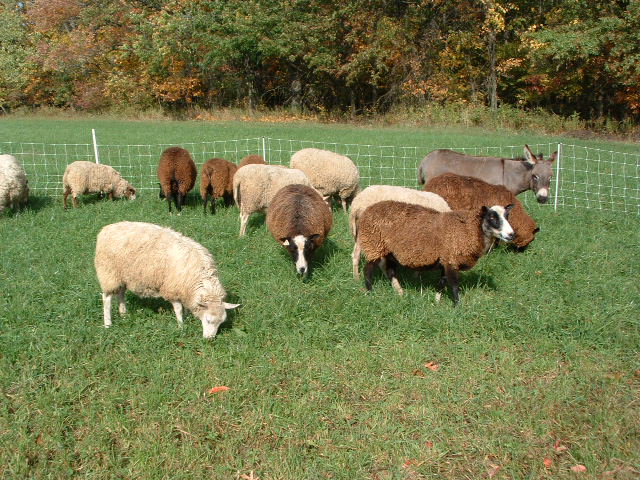
Finnsheep have a similar range of fleece colors to that of Shetland and Icelandic sheep. White is genetically dominant and the most common color. Black and black/white piebald (spotted) sheep are also fairly common, while brown, grey and fawn Finnsheep are very scarce in the USA at this time. (Only 2% of all Finn Sheep are Brown or Grey)
***Eldorado Finns produced over 30% Brown, Grey & Fawn lambs for 2010
Markings such as white stockings, tail tips, white crown or facial markings including the panda-like eyespot pattern are common in colored Finnsheep.
**Information from Wikipedia.com
*** FROM ELDROADO FARMS YEARLY TOTALS

